
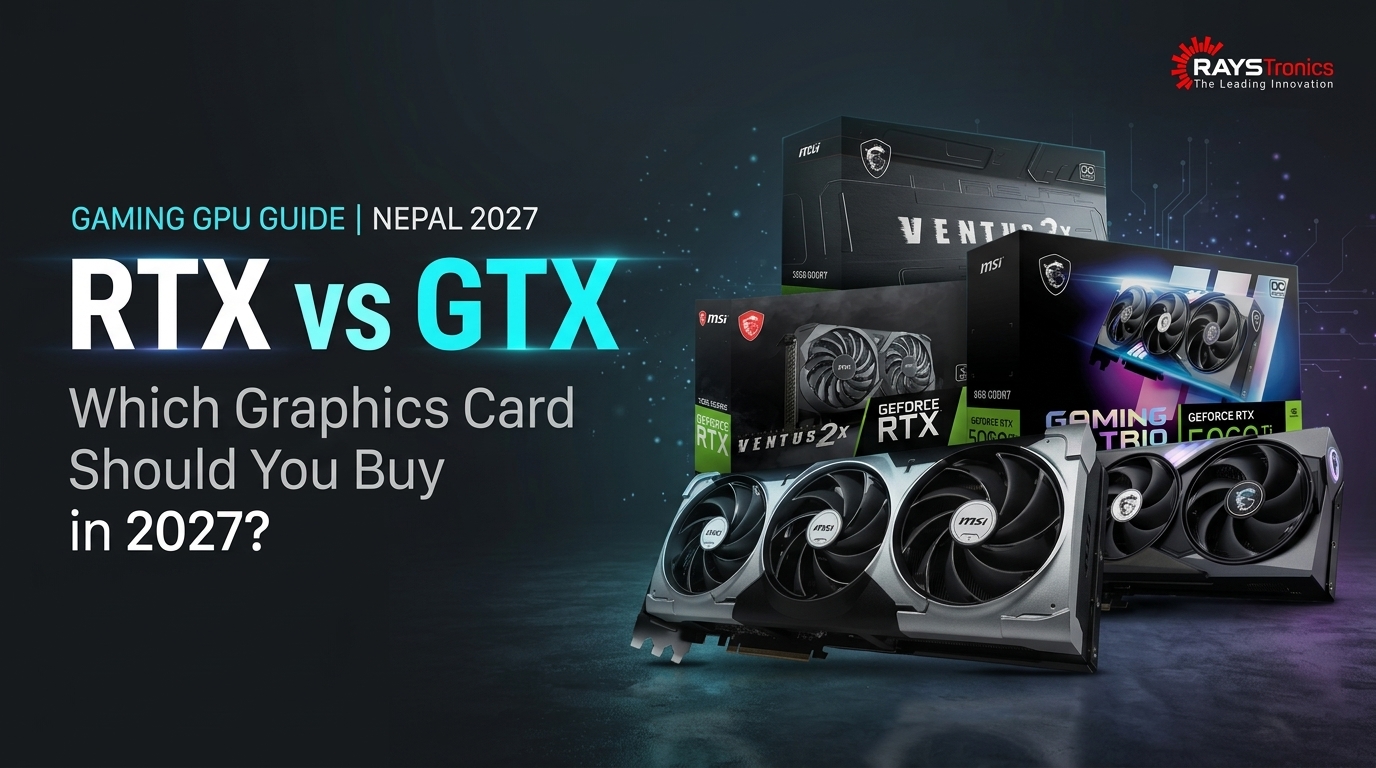
NVIDIA RTX vs GTX Graphics Cards for Gaming in Nepal: Which Should You Buy in 2027?
Choosing a graphics card for gaming is not just about buying the newest model or choosing the one with the highest VRAM. The difference between NVIDIA's RTX and GTX graphics cards can affect the games you play, the visual features you can use and how well your PC handles newer titles.
For buyers in Nepal, the decision also comes down to the actual models and prices available in the market. NVIDIA's RTX lineup includes newer graphics technologies such as hardware-accelerated ray tracing and AI-powered DLSS features, while GTX cards belong to older generations that generally lack dedicated hardware for these technologies.
Raystronics' current product list supplied for this guide includes several RTX 50 Series and RTX 30 Series graphics cards, alongside a few entry-level GT models. It does not include a GTX product listing, so this guide explains the RTX-versus-GTX difference while comparing the products that are actually listed.
Let's look at what separates these graphics cards, how much the generation matters and which models are worth considering for different budgets.
1. What Is the Difference Between NVIDIA RTX and GTX?
RTX and GTX are NVIDIA GeForce graphics card families, but they are built around different generations of technology.
RTX graphics cards are designed with dedicated Ray Tracing Cores and Tensor Cores. These allow supported games to use hardware-accelerated ray tracing and AI-powered features such as DLSS. Newer RTX generations also introduce more advanced versions of these technologies.
GTX graphics cards are older gaming-focused models. For example, the GTX 16 Series uses NVIDIA's Turing architecture but does not include dedicated Ray Tracing Cores or Tensor Cores. As a result, it does not support the same hardware-based ray tracing and DLSS features found on RTX cards.
| Feature | NVIDIA RTX | NVIDIA GTX |
|---|---|---|
| Dedicated Ray Tracing Cores | Available on RTX generations | Not available on GTX 10/16 Series |
| Tensor Cores | Available on RTX generations | Not available on GTX 10/16 Series |
| DLSS Super Resolution | Supported, depending on generation and game | Not supported on GTX 10/16 Series |
| Frame Generation | Available on selected newer RTX generations | Not supported |
| Main advantage | Modern gaming features and broader AI-assisted rendering support | Can still handle suitable older or less demanding games |
| Best suited for | Newer games, ray tracing and modern gaming systems | Lower-cost systems where older gaming performance is sufficient |
One important point: not every RTX graphics card supports every RTX feature. Support depends on the GPU generation, the specific feature and whether the game supports it. An RTX 30 Series card, for example, does not have the same Frame Generation capabilities as an RTX 40 or RTX 50 Series card.
2. What Do Ray Tracing and DLSS Actually Do?
Two of the most important differences between RTX and older GTX graphics cards are ray tracing and DLSS.
Ray Tracing
Ray tracing is a rendering technique that simulates how light behaves in a scene. It can produce more realistic reflections, shadows and lighting effects in supported games.
For example, reflections on glass, water and polished surfaces can appear more realistic when ray tracing is enabled. However, these visual improvements require additional processing power.
RTX graphics cards use dedicated Ray Tracing Cores to accelerate this work. The performance you get still depends on the GPU model, game, resolution and ray tracing settings. An entry-level RTX card should not automatically be expected to run demanding games with maximum ray tracing settings smoothly.
DLSS (Deep Learning Super Sampling)
DLSS is NVIDIA's AI-powered graphics technology. It can improve performance by rendering a game internally at a lower resolution and using AI to produce an output image at a higher resolution.
Newer RTX generations support additional DLSS features, including Frame Generation on RTX 40 Series and Multi Frame Generation on RTX 50 Series. These features can generate additional frames in supported games.
However, generated frames are not the same as frames rendered directly by the GPU. They can improve perceived smoothness, but they do not replace strong underlying rendering performance. Game support, image quality and responsiveness should all be considered.
This is why choosing an RTX card based only on the number of DLSS features advertised is not enough. The actual GPU performance still matters.
3. NVIDIA RTX 50 Series Graphics Cards and Prices in Nepal
The RTX 50 Series is based on NVIDIA's Blackwell architecture. It brings newer Ray Tracing and Tensor Core generations, along with advanced DLSS features, including Multi Frame Generation.
For buyers planning a new gaming PC, the RTX 50 Series offers a range of options, from comparatively affordable models to high-end graphics cards.
Here are the RTX 50 Series models and prices listed in the Raystronics product information provided for this guide.
| Graphics card | Listed price |
|---|---|
| MSI RTX 5090 VENTUS 3X OC 32GB | NPR 1,569,600 |
| MSI GeForce RTX 5080 16G Ventus 3X OC | NPR 458,450 |
| MSI RTX 5070 Ti 16G SHADOW 3X OC | NPR 279,600 |
| MSI RTX 5070 12G Gaming Trio OC | NPR 197,900 |
| MSI RTX 5070 12G SHADOW 2X OC | NPR 192,800 |
| MSI RTX 5060 Ti 16G Ventus 2X OC PLUS | NPR 177,000 |
| MSI RTX 5060 Ti 8G Gaming Trio | NPR 120,500 |
| MSI RTX 5060 Ti 8G SHADOW 2X OC PLUS | NPR 113,900 |
| MSI RTX 5060 8G Ventus 2X OC | NPR 95,000 |
| MSI RTX 5050 8G Shadow 2X OC | NPR 82,700 |
Prices are based on the Raystronics product information supplied for this guide. They may change, and product availability should be confirmed on the individual product pages before purchasing.
Which RTX 50 Series model should you consider?
-
RTX 5050: A lower-priced entry point into the RTX 50 Series. Consider it when building a more budget-conscious gaming PC.
-
RTX 5060: Another option to compare for a mainstream gaming build. Look at game-specific benchmarks and your target resolution before choosing it over the RTX 5050.
-
RTX 5060 Ti: Available in both 8GB and 16GB configurations in the supplied listings. The 16GB version offers more memory capacity for demanding textures and memory-heavy workloads, but more VRAM does not automatically mean proportionally higher performance.
-
RTX 5070 and RTX 5070 Ti: Worth comparing for more demanding gaming requirements. The RTX 5070 Ti listing has 16GB of memory, while the RTX 5070 listings have 12GB.
-
RTX 5080 and RTX 5090: High-end options for buyers with demanding performance requirements and the budget to build a suitable supporting system. They are not necessary for every gaming PC.
The most expensive card is not automatically the right choice. Your display, CPU, power supply and the games you actually play should influence the decision.
4. NVIDIA RTX 30 Series Graphics Cards: Are They Still Worth Considering?
The RTX 30 Series is based on NVIDIA's Ampere architecture. These graphics cards include dedicated Ray Tracing Cores and Tensor Cores and support DLSS features such as Super Resolution.
They do not support the hardware-based Frame Generation introduced with the RTX 40 Series, but they can still be relevant for buyers comparing older-generation RTX options against newer entry-level cards.
Raystronics' supplied product list includes the following RTX 30 Series models:
| Graphics card | Listed price |
|---|---|
| MSI RTX 3060 VENTUS 12GB 2X OC | NPR 111,650 |
| MSI RTX 3060 Ventus 2X 12G OC | NPR 95,000 |
| MSI RTX 3050 VENTUS 2X XS 8G OC | NPR 77,500 |
| MSI RTX 3050 VENTUS 2X 6G OC | NPR 59,700 |
Should you buy an RTX 3060 or RTX 3050?
The RTX 3060 and RTX 3050 belong to an older generation, but that does not automatically make them bad choices. Their value depends on the price, the games you play and how they compare with newer alternatives.
The RTX 3060 listings above both specify 12GB configurations, but they have different product pages and listed prices. Do not assume the higher-priced listing is better simply because it costs more. Compare the exact product model, SKU, physical specifications and warranty details before deciding.
The RTX 3050 is available in two different memory configurations in the supplied listings: 6GB and 8GB. These are not identical configurations, so compare the exact card rather than treating every RTX 3050 as the same product.
A newer GPU should not be rejected just because it has less VRAM, and an older GPU should not be selected just because it has more. Actual gaming performance depends on more than memory capacity.
5. What About NVIDIA GT Graphics Cards?
There is another naming category that buyers should understand: GT is not the same as GTX.
NVIDIA GT graphics cards are generally entry-level products intended for basic display output and light graphics tasks. They should not be confused with dedicated gaming GPUs from the GTX or RTX families.
The supplied Raystronics listings include these GT models:
| Graphics card | Listed price |
|---|---|
| MSI GeForce GT 1030 Aero ITX 4G D4 OC | NPR 30,500 |
| MSI GeForce GT 730 | NPR 18,450 |
| MSI GeForce GT 710 2GD3H LP | NPR 14,000 |
| MSI GeForce N210-1GD3/LP | NPR 10,000 |
These cards may be suitable for basic display requirements or certain older applications, depending on system compatibility. They should not be treated as modern gaming recommendations.
If your main goal is to play current PC games, compare dedicated gaming GPUs such as the RTX 5050, RTX 5060 or other suitable models instead.
6. How Much VRAM Do You Need for Gaming?
VRAM, or video memory, stores graphics data that the GPU needs while rendering a game. It is important, particularly when using higher-resolution textures, larger game assets and demanding graphics settings.
However, VRAM capacity alone does not determine how fast a graphics card is.
For example, an RTX 3060 with 12GB of VRAM is not automatically faster than an RTX 5060 with 8GB. They belong to different GPU generations and have different processing hardware. A proper comparison needs real benchmarks using the same game, resolution and settings.
Here is a practical way to think about VRAM:
-
6GB: A more limited capacity that may suit lower-budget systems and less demanding settings, depending on the game.
-
8GB: A common capacity for entry-level and mainstream gaming configurations. Suitability depends on the game's texture settings and resolution.
-
12GB: Provides more room for larger textures and demanding game assets.
-
16GB or more: Offers additional capacity for high-resolution textures, demanding games and some creative workloads.
Do not buy a graphics card based on VRAM alone. GPU performance, memory bandwidth, architecture, cooling and price all matter.
7. What Should You Check Before Buying a Graphics Card in Nepal?
A graphics card is only one part of a gaming PC. Choosing a powerful GPU without checking the rest of your system can lead to compatibility problems or wasted performance.
Before purchasing, consider these points:
1. Power supply compatibility
Check the graphics card's recommended power supply requirements, power connectors and the quality of your PSU. Do not choose a power supply based only on its advertised wattage.
2. Physical dimensions
Graphics cards differ in length, thickness and cooler design. Check the exact card dimensions against your PC case, especially if you are choosing a larger triple-fan model.
3. CPU pairing
A very powerful GPU paired with an unsuitable processor can limit performance in CPU-heavy games. Aim for a balanced system rather than spending the entire budget on the graphics card.
4. Monitor resolution and refresh rate
Your monitor affects which GPU makes sense. A 1080p display, a 1440p high-refresh-rate monitor and a 4K display place different demands on the graphics card.
5. Exact model and warranty
Check the full product name, memory configuration, manufacturer specifications and warranty details on the product page. Two cards with the same GPU name can have different cooling designs, dimensions and factory clock settings.
8. Frequently Asked Questions
Is NVIDIA RTX better than GTX for gaming?
Newer RTX graphics cards generally offer more advanced features, including dedicated ray tracing hardware, Tensor Cores and support for newer DLSS technologies. However, performance still depends on the exact GPU model. A card's RTX branding alone does not guarantee that it will outperform every older GTX card in every game.
Can GTX graphics cards run modern games?
Some GTX graphics cards can still run modern games, particularly less demanding titles or older games. However, performance and supported features depend on the specific model. GTX cards also lack the dedicated Tensor Cores and Ray Tracing Cores found in RTX generations.
Does every RTX graphics card support Frame Generation?
No. Feature support varies by generation. RTX 40 Series supports DLSS Frame Generation, while RTX 50 Series supports Multi Frame Generation. RTX 30 Series supports DLSS features such as Super Resolution and Ray Reconstruction, but not the same hardware-based Frame Generation capabilities.
Is an RTX 3060 12GB better than an RTX 5060 8GB?
You cannot determine that from VRAM capacity alone. The RTX 3060 and RTX 5060 use different GPU architectures and processing hardware. Compare reliable benchmarks for the games and settings you actually use before deciding.
Are GT 1030, GT 730 and GT 710 gaming graphics cards?
They are entry-level GT products, not GTX or RTX gaming cards. They may serve basic display or limited graphics requirements, but they are not sensible first choices for a modern gaming PC.
Which graphics card should I buy for a gaming PC in Nepal in 2027?
Start with your total PC budget, target resolution and the games you want to play. Compare the RTX 5050 and RTX 5060 for lower-priced RTX 50 Series options, consider the RTX 5060 Ti or RTX 5070 family for more demanding requirements, and evaluate older RTX 30 Series cards only after checking their actual performance and price.
Conclusion
The difference between NVIDIA RTX and GTX graphics cards goes beyond their names. RTX generations bring dedicated ray tracing and AI hardware, while older GTX models remain relevant mainly for buyers with more limited requirements or budgets.
For a new gaming PC in Nepal, a suitable RTX card is generally the more forward-looking choice. The best model, however, depends on your budget, monitor, game library and supporting hardware.
Raystronics' supplied listings include RTX 50 Series and RTX 30 Series options across a wide price range, along with entry-level GT models. Compare the exact product specifications and current listed prices before making a decision. A balanced graphics card and PC build will serve you better than spending more simply to own a higher-numbered GPU.


